
You probably clicked this hoping for a single name and a specific date. We wish history were that simple.
Finding the “oldest” religion is like trying to find the first person to ever tell a joke. We know it happened long before anyone wrote it down.
Scholars debate this question fiercely. Do we count written texts? Do we count statues? Or do we look at the very first signs of burial rituals?
The answer depends entirely on how you define “religion.”
We are going to break down the top contenders based on physical evidence. We will look at the oldest living faiths and the ancient practices that set the stage for them.
The Strongest Living Contender: Hinduism
If you ask most historians for the oldest religion still practiced today, they point to Hinduism.
Followers call it Sanatana Dharma, which translates to “the eternal order.” It does not have a single founder like Jesus or Buddha.
Instead, it is a massive collection of traditions that merged over thousands of years in the Indus Valley.
The Proof:
- The Rig Veda: This is the oldest of the sacred books. Philologists (language experts) date the text to roughly 1500 BCE.
- Oral Tradition: Before writing, priests memorized these hymns perfectly. The linguistic roots suggest these chants go back to 4000 years ago or more.
- Archaeology: We find bull motifs and “proto-Shiva” figures in the Harappan civilization ruins dating back to 2500 BCE.
You can visit Varanasi in India today. It is one of the oldest continuously inhabited cities on earth, and the fires of worship there have burned for millennia.
The Forgotten Monotheism: Zoroastrianism
Many students overlook this one, but it is critical. Zoroastrianism was the state religion of three mighty Persian empires.
It introduced concepts that you know well: heaven and hell, a final judgment, and a battle between good and evil.
Historians believe it deeply influenced Judaism, Christianity, and Islam.
The Proof:
- Linguistic Dating: The holy texts, known as the Gathas, are written in an ancient language very similar to the Sanskrit of the Rig Veda. This places its origin between 1500 and 1000 BCE.
- Excavations: Fire temples across Iran and Central Asia show continuous use for thousands of years.
The Pre-Civilization Shock: Göbekli Tepe
Now we leave the “written” religions and dig into the dirt. This is where the timeline gets shocking.
For a long time, we thought humans invented farming, built cities, and then built temples.
A site in modern-day Turkey called Göbekli Tepe flipped this theory upside down.
The Proof:
- The Stones: Massive T-shaped pillars arranged in circles. They are carved with lions, scorpions, and vultures.
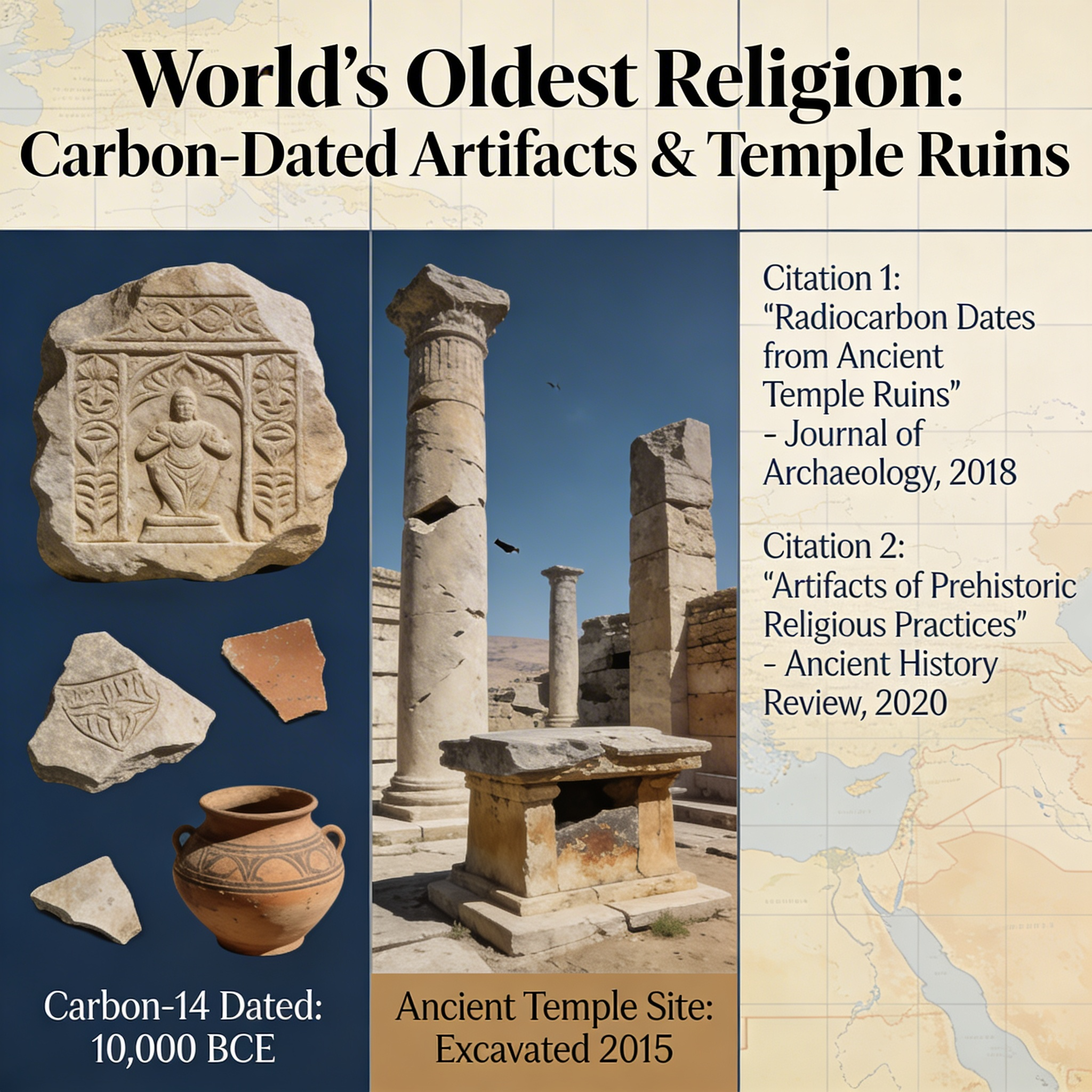
- The Date: Carbon dating places this site at nearly 11,500 years ago. This is 7,000 years older than the Great Pyramid of Giza.
- The Implication: Hunter-gatherers organized a massive workforce to build a temple before they settled down. Religion likely birthed civilization, not the other way around.
The Cave Rituals: Animism
Before temples, we had caves. Animism is the belief that everything—trees, rocks, animals, weather—has a spirit.
This is likely the “default” setting of the human brain. It is not an organized institution, but it is the root of all spiritual thought.
The Proof:
- The Lion Man: A statue found in a German cave. It has a human body and a lion’s head. It is 40,000 years old. This proves humans could imagine beings that did not exist in the physical world.
- Cave Paintings: The art in Lascaux (France) or Sulawesi (Indonesia) often depicts rituals. These are not just doodles; they are sacred spaces used for initiation or prayer.
The First Signs of Hope: Burial Rites
The most profound proof of religion is how we treat our dead.
Animals leave bodies behind. Humans prepare them for a journey. This suggests a belief in an afterlife or a non-physical realm.
The Proof:
- Qafzeh Cave: In Israel, we found human skeletons stained with red ochre (a clay pigment). They were buried with deer antlers.
- The Date: These graves are roughly 100,000 years old.
- The Meaning: You do not waste resources burying a body with “gifts” unless you believe they are going somewhere else. This is the dawn of symbolic thought.
The Mother Goddess
Across Europe and Asia, archaeologists keep finding the same thing. Small, curvy female figurines with exaggerated features.
The most famous is the Venus of Willendorf.
The Proof:
- Consistency: These figures appear across thousands of miles and thousands of years (approx. 30,000 BCE).
- Interpretation: They likely represent a fertility cult or a Mother Goddess worship. It suggests a shared spiritual language among ancient tribes.
Why We Started Believing
Psychology offers a fascinating explanation for all this evidence. We call it the “Hyperactive Agency Detection Device” (HADD).
Imagine you are an early human. You hear a rustle in the grass.
- If you think it is the wind and you are wrong, you get eaten by a tiger.
- If you think it is a tiger (or a spirit) and you are wrong, you just lose a little energy running away.
Evolution favored the paranoid. We survived because we attributed “intent” to everything around us.
Over time, this evolved. We stopped seeing spirits just in the grass and started seeing them in the stars, the seasons, and death itself.
The Verdict
So, who wins the title?
- Oldest Text: The Pyramid Texts of Egypt or the Sumerian Kesh Temple Hymn.
- Oldest Living Faith: Hinduism.
- Oldest Temple: Göbekli Tepe.
- Oldest Practice: Burial rites and Animism.
We are, by nature, looking for meaning. The evidence shows that as long as we have been human, we have been looking up at the sky and asking “Why?”
Studying these ancient roots helps us understand modern faith. We are not so different from the people who painted the caves. We are all trying to make sense of the dark.